for part 3 of the assessment I have investigated a few lines of future professional work. I had a look at working in a professional photo lab like Peak Imaging in Sheffield. I spoke to peak and Lawrence about the career path in this sector. My main focus is on continuing my education. I have done extensive research about doing and getting funding for an MA/MFA. I have also looked at jobs available in publishing, I actually looked for vacancies and assessed how they might work for me. I have also included a small section on working as a freelance photographer producing websites and food photography for a hospitality business.
WORKING IN A PROFESSIONAL PHOTOGRAPHIC LAB
I am intersted in looking at duifferent kinds of printing and maybe working in a professional lab
I spoke to Lawrence and we started work in a photographic lab in Colchester in the 1980’s. they are all closed now. it was the thatcher years and all aprentaships had been abolished so he started as a kind of trainee and then worked his way up. This was pre digital and in fact he used some of the very first digital printers. At that time Lawrence would probable of been using processing machines like we use in the dark rooms.
I have been using a lab called Peak Imaging which is based in Sheffield which is good because they have soft water so cleaner negatives. They don’t do any analogy printing any more but do develop film. I asked weather they had anty apprenticeships available of ever employed trainees. the woman explained that they only have 9 members of staff and their newest member of staff started 15 years ago somer have been there for 30 they are like a family and are very happy. it must be a really nice to work as no one ever leaves. she did say that if the pandemic wasn’t happening they would occasionally have people for work experience.
I asked about the structure of the company and she said there were different heads of department overseeing Film processing, Head of scanning, digital, mounting , framing and printing. there was also a graphics department, light books. For professional photographers Lee or Simon would happily give a personal service tailored to the needs of each image. they use Fuji Frontier and Durst digital printers.
realistically I don’t think I actually want to go and work in a photo lab as a long term career am not sure I am young enough to build up a skill set in that industry. I am still interested in printing and Art Photography and would like to pursue my ambition to continue studying for an MA or MFA. and MFA has 60 extra credits.
DOING A MASTERS DEGREE
the first question is HOW DO I GET FUNDING ?? funding for postgraduate
It is possible to get another student loan from the government to complete a masters according to the Govt website to Toal loans available are below and this is the total amount to pay tuition fees and maintenance.
- £11,222 if your course starts on or after 1 August 2020
- £10,906 if your course started between 1 August 2019 and 31 July 2020
- £10,609 if your course started between 1 August 2018 and 31 July 2019
Depending on where you studied this would probable only cover your basic living expenses, and more if you were in London
the average cost of tuition fees are about 4000 to 8000
OTHER FUNDING OPTIONS
RESEARCH COUNCILS.
For postgraduates, the best place to start is with an appropriate research council such as the Arts and Humanities Research Council (AHRC). Problem is, money’s limited and the chances of actually getting funding from research councils are fading by the day. Not only are research councils incredibly competitive, the application process which is carried out through the university, is painfully lengthy so it’s wise not to pin all your hopes on winning funding from one of these guys. That being said, research councils do fund a large number of UK students.
University Bursaries and Studentships
Most universities will have a range of bursaries and studentship awards available for their postgraduate students. Some may cover the costs of your tuition fees and living, others will be set amounts such as £1,000. These awards however are limited, as they are usually funded through donation or special schemes.
The university of arts UAL has 150 £5000 scholarships for students available to.
Another fantastic resource worth investigating is PostgraduateStudentships.co.uk. Their site is dedicated to bringing together all the different funding opportunities open to postgraduates, at both taught and research level, across the UK.
CHARITABLE TRUSTS.
there is quite a few and lots of research is needed . I looked zt the Welcome trust but their funding for education is more science and health based, but they do run very interesting competitions about photography and mental health.
FUNDING THE FUTURE FOR WOMEN
Funding For Women Graduaters is another charitable trust. ‘The advancement of education and promotion of higher education and wider learning of women graduates’
I am not going to investigate this further as I would like to be self funded or get a loan and leave scolourship or charitable nurseries available for other people to use.
Where to study an MA or MFA
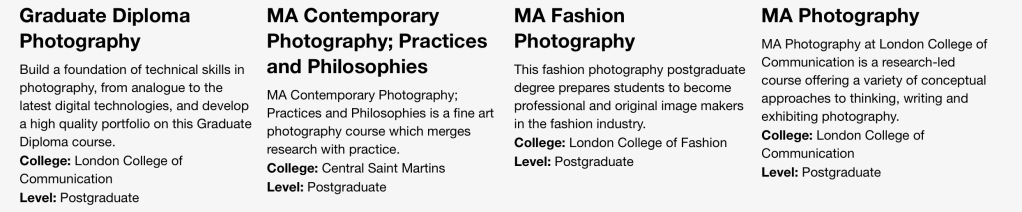
MA Photography at London College of Communication offers a variety of conceptual approaches to thinking, writing and exhibiting photography. As a research-led course, it equips students for a wider inquiry into the interdisciplinary aspects of the photographic medium by developing a single exhibition project over the 15-months duration of the course.
EXAMPLE CARRER PATH OF OTHER ARTISTS
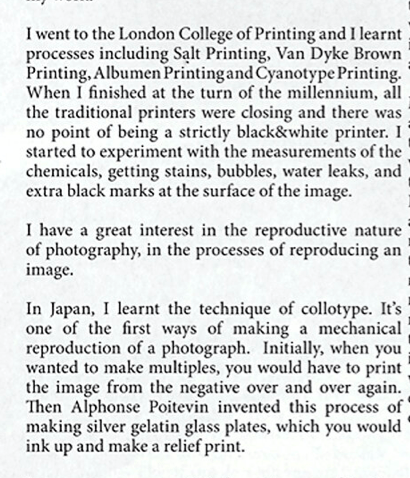
The artist Anthony Cairrns describes his time at the London college of printing
Anastasia Taylor-Lind is an English/Swedish photojournalist who works for leading editorial publications all over the world on issues relating to women, population and war.
She is a 2016 Harvard Nieman Fellow and spent a year at the university researchng war, and how we tell stories about modern conflict. Anastasia is also a TED fellow and a 2017 non-fiction Logan Fellow at The Carey Institute for Global Good.
As a photographic storyteller, her focus has been on long-form narrative reportage for monthly magazines. She is a National Geographic Magazine contributor, and also works for TIME, Vanity Fair, The New Yorker, The New York Times, The Sunday Times, The Telegraph and The Guardian. Commercial clients include DOVE, Wellesley College, P&G, and Always.
Her first book MAIDAN – Portraits from the Black Square, which documents the 2014 Ukrainian uprising in Kiev, was published by GOST books the same year.
Anastasia’s work has been exhibited internationally, in spaces such as The Saatchi Gallery, The Frontline Club, and The National Portrait Gallery in London, SIDE gallery in Newcastle, Fotografiska and Fovea Exhibitions in New York, Pikto Gallery in Toronto and The New Mexico Museum of Modern Art in Santa Fe.
A wide variety of organizations have recognized and supported her projects through awards such as the POYi, Sony World Photography Awards, Royal Photographic Society Bursaries and the FNAC Grant at Visa Pour L’Image.
Anastasia has degrees in Documentary Photography from the University of Wales Newport (BA) and the London College of Communication (MA)
University for the Creative Arts. Falmouth .With internationally-recognised and award-winning teaching staff, this rare two-year MFA Photography course gives you a unique opportunity to become true experts in the field of photography.
Led by award-winning photographer Anna Fox and supported by an exceptional team – including award-winning photographer Karen Knorr, photographer and video artist Ori Gersht, Professorial Fellow Sunil Gupta and talented sessional staff – you will be given the tools, the freedom and the time to hone your skills and find your professional place within the industry. Paul Seawright You’ll have more time to explore your craft and creative ideas, as well as investigating what you will do in your professional career, whether that’s practical, theoretical or a mix of the two.
FAMOUS MASTERS COURSES
The Paris college of arts is an excellent college.
Yale school of arts – MFA Photography
PHOTOGRAPHY (MFA) YALE
Program overview
Photography is a two-year program of study admitting ten students a year. Darkroom, studio, and computer facilities are provided. Students receive technical instruction in black-and-white and color photography as well as nonsilver processes and digital image production.
The program is committed to a broad definition of photography as a lens-based medium open to a variety of expressive means. Students work both individually and in groups with faculty and visiting artists. In addition, a critique panel composed of faculty and other artists or critics meets weekly, as well as for a final review each term, to discuss student work.
Rhode Island school of art
Graduate students in the program develop visual and critical expertise through course work, seminars, independent studio work and critiques designed to provide a deep understanding of contemporary art practices and criticism. Working in personal studios, students have access to state-of-the-art technical facilities that allow for the exploration of film-based and digital photography, digital video and multimedia production.
MFA candidates achieve a high level of technical mastery and create a coherent body of visual work representing a sustained and sophisticated investigation of ideas. They are also expected to write and speak about their work with an advanced level of fluency and to frame their practice in historical and critical contexts.
THE BIG LONDON COURSES, THE MOST FAMOUS AND PRESTIGIOUS
the royal college of art
what I like about this is that you get given complete freedom and a space/studio to work from. obviously the tutors look amazing
An expanded and interdisciplinary art practice with no fixed identity.
The Photography programme provides an environment where you can develop as an artist with photography at the core of your practice. We offer a platform where students can articulate ideas through making work and can reflect critically upon what they have made.
University of Westminster = Ma photography.
this course is very prestigious. photographic education at the University of Westminster has a unique depth of tradition. Classes in photography were taught at the Polytechnic Institution, the forerunner of our University, from 1852, and the School of Photography was established in 1883
Photography BA course is a long-established course with an excellent international reputation for its academic and practical teaching. This reputation is reflected in high application rates, a distinguished record of graduate employment in the industries it serves, and in the publication, production and teaching profile of its staff and graduates.
the course is renowned for its distinctive philosophy, which aims to provide a holistic photographic education. It combines high levels of technical and visual photographic skills with excellent visual literacy and a critical awareness of visual culture alongside solid professional practice.
LONDON COLLEGE OF COMMUNICATION, UAL
MA PHOTOGRAPHY
I have to say this cause looks brilliant. the teaching staff are inspirational.
MA Photography at London College of Communication offers a variety of conceptual approaches to thinking, writing and exhibiting photography. As a research-led course, it equips students for a wider inquiry into the interdisciplinary aspects of the photographic medium by developing a single exhibition project over the 15-months duration of the course.
The Media School offers a longstanding tradition of photography education with a highly regarded artistic research culture, and the course has close ties with the Photography and the Archive Research Centre and The Stanley Kubrick Archive, both based at London College of Communication.
I would love to go to any of the three above courses. I will start thinking about my application now. not feeling very confident to be honest. just need to focus of finishing this course first !
Norwich school of art
MA Photography I could do this part time from my house in Suffolk
Although I shouldn’t be lead by geography but realistically this school is near to my house so would be manageable as a commute.
Course length: Full-time 1 year, Part-time 2 years
All courses starting in September 2020 will run as a blend of on-campus and digital teaching and learning and will follow UK government safety advice. We may need to adjust course delivery if advice changes. We will notify applicants and students of any changes directly.
Innovation of your practice and the development of critically-informed perspectives are the guiding principles of our MA Photography Masters degree course.
State-of-the-art studios and digital darkrooms will give you freedom to develop a distinctive authorial voice through advanced study of photographic practice.
Norwich school of art – Theory and practice
While our postgraduate photography course is practice-led, taught components consider contextual and theoretical aspects of photography. From collaboration, aesthetic/anti-aesthetic and technological determinism, to the impact of emerging technologies, you’ll tackle a wide range of topics related to your practice.
Art communities
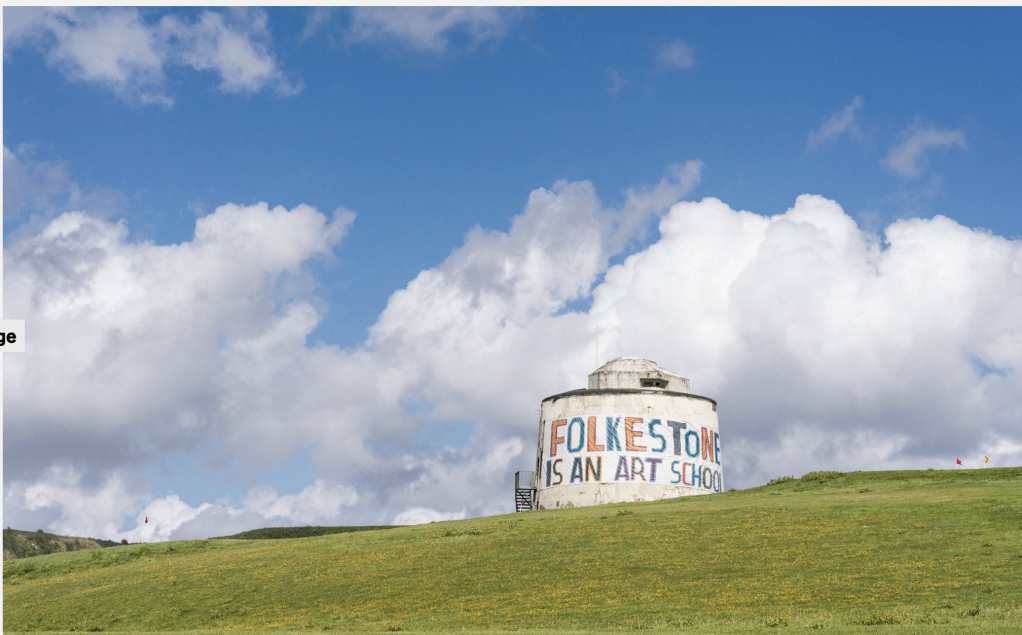
my dilemma also is that I do not want to go into a metropolitan/urban city to study. so need to work on that ! there is an exodus from London to places like Folkstone in Kent , or Hendon bridge in Yorkshire. of course colchester has the fist sight gallery and an art school but they don’t do MA’s.
My dream
I would like to win the Hariban award. it is an photographic competition run by a Japanese company called Benrido who run a collotype printing academy. the prize is spending 2 weeks in Keyoto with the master printers printing your photographs using this incredible traditional method. it uses glass plates and pigment inks and produces prints of incredible detail. ome of my hero’s Awoiska van Der Molen won the award in 2015 and her work is amazing. her latest book called The living Montain is incredible!
Having done this research I feel incredibly inadequate and don’t believe I have a chance in hell of getting on to any of these programmes !! but I am going to try and actually nice I wrote this last year I do feel more confident.. I defiantly feel more passionate about my practice and feel I am just getting to grips with understanding the basic language of photography and want to explore this further.
additional research –
Peak imaging Imaging Q and A
sRGB is the most common colour space for photographic printers and therefore working with a larger colour space does not offer any advantage and often can lead to producing a inferior print.
8-Bit or 16-Bit?
From a purely theoretical standpoint editing in 16-bit space is better than 8-bit space. A higher bit depth means you have finer steps to adjust, however, from a practical standpoint, there is no difference. This is due to the fact that photographic and commercial printing equipment is calibrated and optimized for 8-bits per channel.
Will I lose quality by sending a JPEG over a Tiff?
The JPEG compression format is a very efficient, lossy image compression algorithm designed specifically for saving photographic images. It takes advantage of how humans see colour versus brightness to only save information needed to reproduce the image for people to view. Image data is lost during compression, but at high levels of quality you will not see a difference between a JPEG and a TIFF printed to photographic paper. JPEG compression is perfect for sending files to the lab.
How should I set up my working environment?
Your work environment influences how you see colour on your monitor and on printed output. For best results you should:-
View your documents in an environment that provides a consistent light level and colour temperature. For example, the colour characteristics of sunlight change throughout the day and affect the way colours appear on your screen.
The amount of lighting is important as well. You should create an environment that is neither too dark, nor too bright. Rather, work in an environment that would be comfortable for reading a book.
View your document in a room with neutral decor. A room’s colour can affect the perception of both monitor and printed material. The best colour for a viewing room is neutral gray.
Remove colourful background patterns on your monitor desktop. Busy or bright patterns surrounding a document interfere with accurate colour perception. Set your desktop to display neutral gray’s only.
What are the differences between the Rendering Intents?
Perceptual (recommended)
Perceptual rendering is intended to preserve the visual relationship between colours so that they are perceived to be as natural to the human eye as possible, even though the colour values themselves may change.
Relative Colorimetric
Relative Colorimetric rendering compares the extreme highlights of the source colour space to that of the destination colour space and shifts all colours accordingly.
Saturation
Saturation rendering is intended to produce vivid colours in an image at the expense of colour accuracy.
Absolute Colorimetric
Absolute Colorimetric intent will leave the colours that fall inside the destination gamut unchanged, whereas the out-of- gamut colours are removed.
 ELIZA FUTURE